Unknown's avatar

About Jessica

Mama of three, history educator, vinyl record collector, sometimes writer, professional amateur.

January 26th, 1700: The Orphan Tsunami and Cascadia Earthquake

It is the year 1700, close to midnight on January 27th, and in the small village of Kuwagasaki along the northeastern Japanese coast, villagers awake to a frightening warning: get to higher ground immediately.  Water has begun to pull back from the shore, exposing the rocks and flora underneath, and a large wave, 2-5 meters in height, has been spotted in the distance.  It is a tsunami. Although not a frequent occurrence, tidal waves like this have come to shore before, and the village leaders know the signs. But, as the water begins to pour into the village, destroying homes and crops in its path, they are puzzled. No earthquake, the usual predecessor — and obvious warning sign — has been felt.  Where did this massive wave come from?

The Orphan Tsunami of 1700 impacted over 600 miles of Japanese coast, miraculously sparing the lives of most of those impacted, but leveling buildings and destroying crops. For almost 300 years, the origins of the waves remained a mystery, until an amazing breakthrough that combined geological research, historical examination of traditional Japanese record keeping, and a sociological look at the oral traditions of the indigenous people of the American Pacific Northwest.
Screen Shot 2018-01-25 at 2.18.15 PM

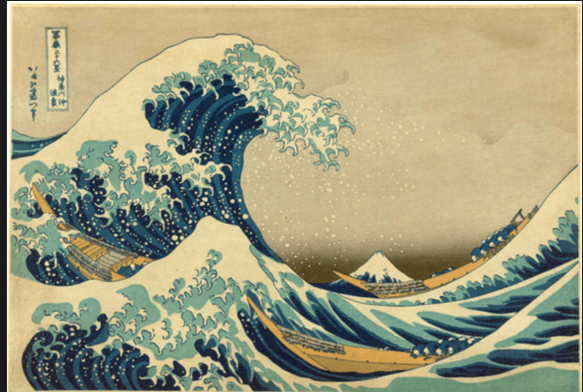
“The Great Wave off Kanagawa,” by Katsushika Hokusai

According to the USGS, 81% of the world’s largest earthquakes occur along the Circum-Pacific Seismic Belt, known in popular culture as the “Ring of Fire.”  Stretching from the eastern shores of Asia to the western shores of the Americas, the Ring unites the hemispheres through a dangerous and active series of plates, faults, and seismic activity. But, which of those plates could produce an earthquake powerful enough to send a tsunami to the shores of Japan, but far enough away for the earth not to shake under her inhabitants’ feet? The answer to this doesn’t only fulfill a historical question, but it provides a modern solution: knowing where powerful quakes originate helps save lives.

As geologists delved further into the concept of plate tectonics in the 1960s, they discovered that some regions are more capable of producing massive, “megathrust” earthquakes that can register high on the Richter scale and precipitate massive damage.  The obvious choice for the origin of such a quake would be the around the Aleutian Arc, relatively close to Japan and a known site of active earthquakes. Still, as geologist Brian Atwater points out in his comprehensive study of the quake, The Orphan Tsunami of 1700, Alaska isn’t a good source. When a massive, 9.2 quake originated from there in 1964, residual tsunami waves in Japan weren’t close to as numerous or powerful as the reports from 1700. Further geological studies of soil deposits placed the last quake of that magnitude there to somewhere around the year 1200, ruling Alaska out completely.

But there was another area of the Pacific Northwest, long thought to be incapable of producing megathrust quakes, that was yielding some interesting results. In the mid-1980s, Atwater and other geologists discovered evidence that the land along the Cascadia region (from Vancouver, B.C. to Northern California) had dropped. Tidal mud and sand were found in layers under solid ground, and the stumps of dead cedar and spruce trees lay buried underneath layers of sediment forming “ghost forests”. Dendrochronologist David Yamaguchi was able to analyze the rings of the dead trees and determine that they were alive until at least 1699, and radiocarbon dating placed the event from 1695-1720. Whatever happened in Cascadia happened quickly -archaeological sites unearthed in the later part of the 20th-century show woven baskets and rocks from encampments completely buried under deposited earth and sand.

It seemed as if science was producing important clues, but historians were unable to verify them through records. The Cascadia of 1700 was a world that would be virtually untouched by Europeans for over 100 years until the Lewis and Clark expedition made it’s way to Fort Clatsop in the winter of 1805. The native tribes did not have written language, so no documents exist that can verify the existence of a massive earthquake,  However, research scientist Ruth Ludwin and others documented oral traditions telling of floods, quakes, and a battle royale between a Whale and Thunderbird – the water and the earth.

In the mid-90s, Japanese research teams with the National Institute of Advanced Industrial Science and Technology and the University of Tokyo put all the pieces together. Transferring traditional Japanese time and date keeping from local zasshos (logs which recorded daily conditions in each magistrate), accounting for differences in longitude, and the nearly 5,000 miles the tsunami would have to travel, the Japanese team established not only a date, but a time.  At 9 p.m. on January 26th, a massive quake struck the Cascadia region, probably just around 9.0 on the Richter scale. Ten hours later, its tsunami hit the shores of the eastern prefectures of Japan.

The date determined by Japanese record keeping from 1700 matched perfectly with geological evidence unearthed centuries later, and local folklore that had been passed on for generations. It proved that the Cascadia subduction zone was and likely still is capable of producing destructive and powerful quakes. It’s not only a piece of the puzzle, but a warning for the future.

This mysterious piece of history was finally solved, thanks to the scientific and anthropological evidence that supported a bold hypothesis and provided the answer to a centuries-old question as to what probably happened.


January 24th, 41 AD – The Assassination of Caligula, Probably

Screen Shot 2018-01-23 at 3.06.35 PM

As far as historical work-related death and dismemberment go, it’s hard to beat the horrific odds facing the Roman emperors. Even if we’re just talking about the Western Empire – from Augustus to Romulus Augustulus, serving in such a position all but guarantees some sort of horrific ending. Sure, there were those who died of natural causes and a select few who successfully abdicated with all their limbs and organs intact, but chances were that a worse fate awaited you. Of the 90-ish emperors we’re considering, somewhere around the ballpark of 55 of them died as a result of either assassination, battle wounds, or at the hands of an enemy to the realm, which I’m guessing was neither quick nor pleasant.

When it comes to dramatic deaths, Caligula’s may seem tame by Roman standards; he was stabbed to death by a group of conspirators in an underground palatial corridor after becoming both tyrannical and debaucherous. He wasn’t poisoned by his own niece like his successor (and uncle) Claudius was.  He didn’t die of a festering battle wound after showing off his bravery by riding into battle without armor like emperor Julian did. He wasn’t strangled to death in the bathtub by a gladiator or intoxicated from eating too many mushrooms and/or breathing in fumes from a charcoal fire – a fate that may or may not have befallen the emperor Jovian.

The only odd thing about the event itself is how closely resembles that of Rome’s first dictator-but-not-actually-an-emperor Julius Ceasar, who was, through a complicated series of adoptions, not only Caligula’s great-great-grandfather but also his namesake. Caligula, as it turns out, was born as Gaius Julius Caesar Augustus Germanicus, following the prominent Roman tradition of naming kids ridiculously long names and then calling them something completely different that was carried on by European royals for hundreds of years.

Caligula’s nickname goes back to his childhood habit of dressing in a little soldier’s uniform to imitate his father, Germanicus, a celebrated general. Caligae was the Roman name for the sandal-like boots soldiers wore, so the sight of little Gaius Julius Caesar Augustus Germanicus marching around little a little soldier begat the nickname of Caligula, meaning Little Boot. Let’s all take a moment to reflect on how adorable that is because it’s really the last remotely heartwarming thing we’re going to discuss when it comes to your dude Caligula, ya heard?

To understand why Caligula was killed, you’d first have to understand how he lived. I’m going to assume that if you are a person of a certain age, you’ve at least heard of the eponymous film about his life, which is a confusing mixture of mid-70s avant-garde and surprisingly graphic unsimulated sex scenes. The crux of the film – and of common discourse-  is that the emperor was an insane and cruel ruler, who not only liked his sister in an un-sisterly type of way, but turned the palace into a functioning brothel with a  revolving cast of characters while his people starved.

Emperor Little Boot’s reputation for the eccentric doesn’t stop at his sexual appetite – the stories are were told about him range from the bizarre to downright extra bizarre, leading many historians and contemporaries to assume he suffered from some sort of insanity. It’s been said that he was so crazy that he appointed his horse to a government position, ordered his troops to invade Britain but once they were there just had them collect seashells from the beach and then go home with their “splendors of the sea”, and that he fed innocent spectators to the bears and lions of the Colosseum.

The problem with much of the recounting about Caligula’s dirty deeds is that much of it is either exaggerated, unsubstantiated, or told through thousands of years of filters like so much of pre-digitized history. Like a game of Telephone where one person relays a story that is then repeated to another, as we get further away from the source, we lose clarity and truth.  In some forms of visual media reproduction, this term has a name; generation loss is what happens when a print is reproduced over and over again until the product is simply a copy of a copy of a copy, less clear and true than its original form. In history, we often don’t have the luxury of knowing when we’ve experienced generation loss. Is this story we’re hearing factual, or has it been intentionally or accidentally altered and embellished over the years?

That’s why Caligula’s death – and life – is a great place to start. Did the things we think we know about him really happen, or have they been lost in translation as his proverbial image was reproduced over the years? We’re dealing with just two major sources to relay most of the really juicy Caligula-related details:  the writings of Roman historian Gaius Suetonius Tranquillus, who wasn’t even born until years after Caligula died, and those of another historian named Cassius Dio, who wasn’t even born until years after Suetonius died.

Suetonius aligned politically with the Senate during his lifetime, and since there were often clashes between Senate and emperor, he had the motivation to paint the emperors of antiquity he wrote about in a bad light, thus providing a historical basis for his beliefs that all emperors sucked. He also intentionally wrote scandalous and salacious little vignettes like a regular old Iron Age TMZ. We need to take anything he said or anything he may have influenced (like Dio’s writings) with a grain of salt. To put it into modern terms, if there were only two major historians who wrote about Abraham Lincoln and one was a Southern sympathizer writing decades after the fact, we’d question the validity of their claims. We should be doing the same thing here.

It’s also important to remember that when we accept a one-dimensional portrayal of a complex historical figure, we’re choosing to ignore things like context, causality, and complexity. In short, it’s a historical cop out.

So, let’s start with the obvious – it’s plausible and probable that Caligula did a lot of the things attributed to him. Remember that aforementioned 60% violent death mortality rate that comes with the job title? That clearly had an impact on the psyche of those in power. The times were brutal, and life was short. Life was brutal and time was short. Most people surviving early childhood only lived into their late 40s or early 50s, and as the third emperor, Caligula surely understood that the absolute rule that his predecessors had established had led to their longevity – Augustus ruled for 40 years, and Caligula’s grandfather and predecessor, Tiberius, ruled for 22 until he was smothered with his own pillow to hasten his death by old age and misadventure.

Caligula was also known to have undertaken stunts – sometimes ridiculous – to prove a political point. When a prophecy declared that there was as much a chance of Caligula becoming emperor as there was of him riding a horse across a local body of water called the Bay of Baiae. Caligula defiantly staged his own “hold my beer” moment, as he ordered the construction of a floating bridge which he then rode his force triumphantly across. Speaking of horses, if he did indeed promise to make his horse a government official (and we’re not quite sure he did), it may have been in the same vein. To mock the ineptitude of the Senate he was constantly at war with, he threatened to symbolically appoint an animal as their equal. Don’t tell me you’ve never wondered if a beloved family pet may be able to do at least as good of a job as some of your co-workers.

But there’s also another layer to Caligula – one that makes it seem completely possible that there was some sort of underlying emotional issues. After his father’s death, Tiberius had Caligula’s mother, Agrippina, banished, and the youngster was basically held as ransom, bounced from one relative to another, in a game of mental chess. His mother and several siblings died in their captivity, and Caligula got to be well versed in playing the role of a dutiful grandson for his survival. Shortly after becoming emperor after Tiberius’s death, Caligula became deathly ill – possibly as the result of poison. While he physically recovered, he was never the same mentally, and his reign turned from generally pleasant to absolutely murderous. He exiled and murdered members of his own family with aplomb and began executing Roman citizens without trial.  He aggrandized and deified himself and sometimes dressed in clothing invoking Jupiter and Apollo, putting statues of himself inside temples where Romans worshipped the Gods he emulated. Eventually, he proposed moving to Egypt, where he felt he would be worshipped the way he deserved. That suggestion proved to be the final straw.

Not quite four years after ascending the throne, Little Boot was dead. Later that day, his wife and one-year-old daughter were also killed, their icons destroyed to wipe any trace of them from the annals of history, and their memories left to the mercy of others, however they may see fit to use them.

So, there you have it. January 24th, 41AD:  the death of Caligula, and the life he led.

Probably.